We've had a fairly uneventful few months. A gentle summer has morphed into a gentle autumn. There have been the occasional musical concerts, a few lovely dining-out experiences and our usual walks, gardening, reading and social catch-ups. We are planning a mid-winter getaway so we've been preoccupied with that.
For want of anything better, I thought I'd record a number of the books that I've enjoyed over these past few months. They're a mixed bag. Our library does not have a huge selection, although they will get a book in for you if you request it. But Christmas followed by my birthday always guarantees a new haul.
All Quiet on the Western Front
After watching the recent German-made movie, I turned to the book to reread it. Written in 1929 by Erich Maria Remarque, it's still a powerfully anti-war novel - a poignant, heartbreaking look at young German boys who volunteered to fight the French on the western front in Belgium and France in World War 1. No wonder Hitler banned it and Goebbels forbade the screening of the first movie made in 1930 in Hollywood (which went on to win an Academy Award).
Voyage to the South SeasI was captivated by this book. The author tells the story from the perspective of the French explorers, naturalists and scientists as they ventured south on voyages of discovery from the 1790s to the 1840s. These were the glory of days of French exploration, the author making the point that they were voyages of discovery, not necessarily to possess territory as the English did (yes, the author is French). I loved the way the book was constructed, with a sketch of the explorer and a brief biography, then two or three pages describing their voyage using contemporary accounts, diaries, letters and other historical documents. The proliferation of French names around our coastline gave these stories an immediate connection to me as I've visited most of these places. While the English changed a lot of names there are still many of French origin. And for those of you, like me, who love to know where names come from...
- Cape Naturaliste and Géographe Bay in W.A. named after the ships of French explorer Nicolas Baudin;
- Point Peron in Western Australia (where I went for high school excursions and which is now an A class conservation reserve) named in 1801 after Baudin's naturalist Francis Peron who accompanied his expedition and whose botanical and zoological findings helped establish the natural sciences in Australia;
- Fleurieu Peninsula, south of Adelaide, South Australia was named by Baudin after the French Minister for the Navy - Charles Pierre Claret de Fleurieu.
- D'Entrecasteaux Channel, Bruny Island and Recherche Bay were named by D'Entrecasteaux as he explored Tasmanian waters in his ship the Recherche in 1792.
- Labillardiere Peninsula on Bruny Island, Tasmania, named after naturalist Jacques Labillardiere who sailed with Bruni D'Entrecasteaux exploring the South Pacific;
- Freycinet Peninsula in Tasmania named by Baudin after the French naval officer and explorer Louis Claude de Saulces de Freycinet who sailed with Baudin charting the Australian coastline 1802/03.
[With acknowledgments to Wikipedia.]
For Christmas, Steve gave me this mega-sized book of short stories by famous crime writers. The authors range from Agatha Christie, Raymond Chandler, Ngaio Marsh, Colin Dexter, to Georges Simenon, Erle Stanley Gardner and Ruth Rendell among many others. Most stories feature the now-famous detective they created, such as Simenon's Inspector Maigret, Raymond Chandler's Philip Marlowe, Dexter's Inspector Morse and, of course, Christie's Hercule Poirot.
Each short story is preceded by a bit about the author and the legendary detective they created. Being short, the tales are read quickly and effortlessly in one sitting. I enjoyed most of the stories though have to admit I'm not a huge fan of the wise-cracking, hard-boiled American private eyes such as Mickey Spillane's Mike Hammer or Chandler's Phil Marlowe (the latter famously personified in Humphrey Bogart's portrayal). However, the book is so heavy it is pretty useless as a 'nighttime-reading-in-bed-book'.

Segueing on from the detective omnibus, I checked out the latest Agatha Christie biography from the library: Agatha Christie: A Very Elusive Woman. Lucy Worsley's work is a wonderful celebration of Christie's life - warts and all. Written in Worsley's inimitable cheery and so-readable style, it's a fascinating, moving and gripping account of the author's life and loves, her books and her family. Wanting to be private but enjoying the money her books brought in, Christie is ultimately a paradox. I loved the many quotes from friends, family, colleagues and those not so enamoured of her, and her writing style, as well as comments about her books and how and why they were written. But she continues to be read, unlike so many of her contemporaries. I simply couldn't put the book down. To me, this is how biographies should be written.
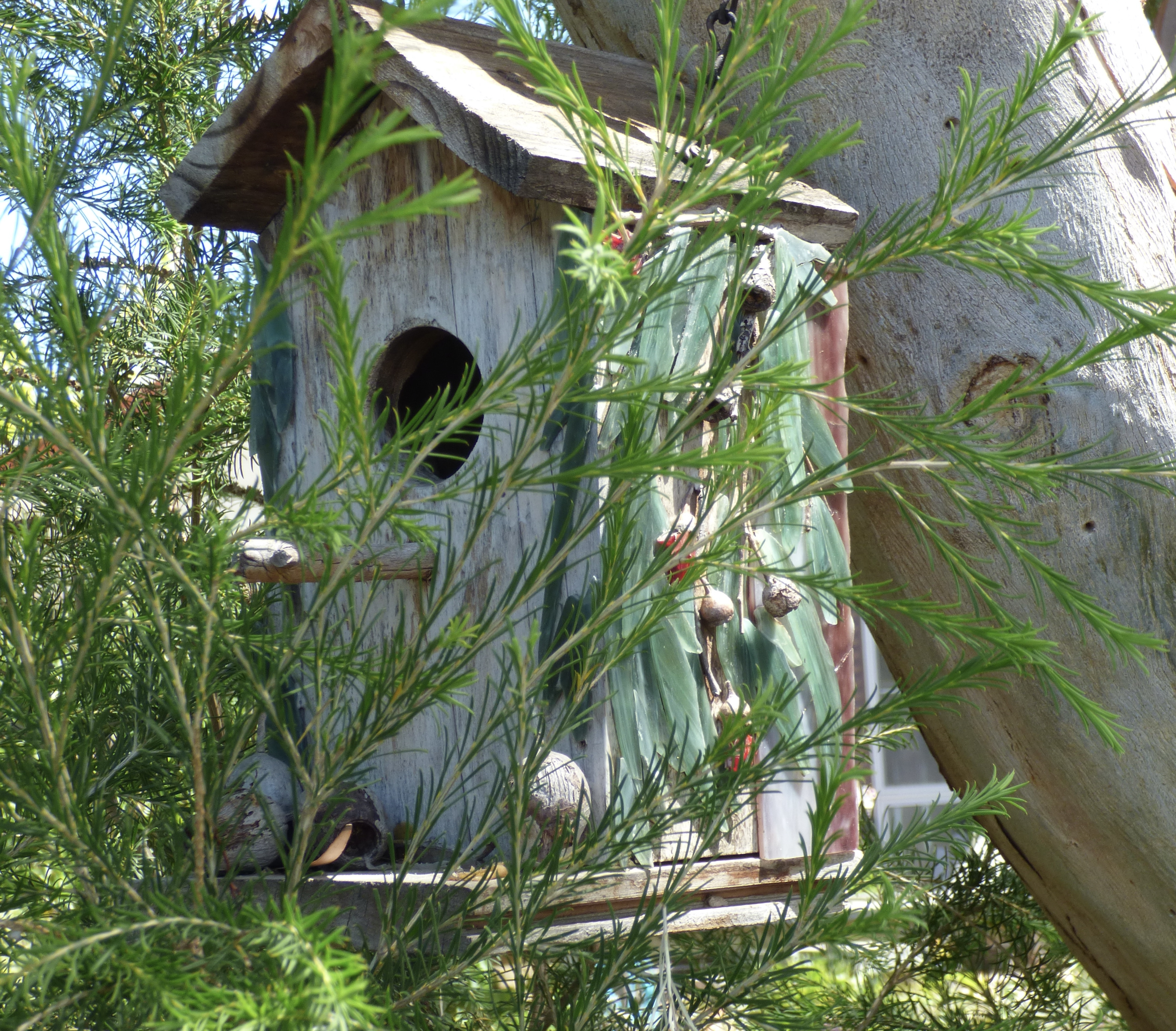
Seeking inspiration to make our courtyard greener, I turned to a book called Urban Oasis by Rebecca Gross. Well, there was certainly a lot of inspiration on hand, although many of the articles and photos were of high rise apartments in New York, Chicago, San Francisco, Sydney and Melbourne. These photos show more of my style. A good browsing book though.

Dave Warner's books were a lovely surprise. I knew his name as the lead singer/songwriter of the band From the Suburbs, but after a few successes he apparently moved into writing plays, novels and screenplays. I'd never read any of his books until now.
River of Salt was a murder mystery set against a nostalgic backdrop of the 1960s music, surf scene, and cultural events. The Australian coastal setting was evocatively and realistically portrayed and the story moved along at a goodly pace with a murder and loads of clues that could point to a number of would-be murderers. But the main event was Warner's anti-hero Blake Saunders, a Philadelphian hitman who has escaped to Australia to save his life from the Mob. Admittedly, Blake is a stereotype - handsome, tough, determined, unscrupulous, shady background, a loner but with ethics and a heart of gold. However, Warner makes you believe in him and trust his instincts. A wonderful escapist crime story. I enjoyed it immensely.
I returned to the library and found one more Warner novel Before it Breaks, another murder mystery, this time set in Broome and its environs. Again, the main character is a bit of a stereotype - a disillusioned detective whose obsession with his work has cost him his marriage and he's now sent to the remote outpost of Broome with, as he sees it, incompetent fellow officers. He's a curmudgeonly loner with his heart in the right place and who never gives up on getting the crims. The landscape is perfectly realised. I do love stories set in places I've been to, so another good read.
Reading one of the last books that Andrea Camilleri wrote about that fabulous Sicilian detective Montalbano made me yearn for the return of the TV series.
The Cook of the Halcyon is the penultimate book in the Inspector Montalbano series (Camilleri having died in 2019). What fun it was. All the elements you'd expect: an intriguing mystery, Montalbano in trouble with his superiors, his girlfriend Livia being argumentative, his close friends being supportive, Sicilian food and, of course, the wonderful portrait of the bumbling Catarelli. The plot zipped along with Montalbano handling each crisis with his usual panache. Loved it. And I could feel that sun warming me as I 'ate' the delicious food.
Now it was time for me to settle into my favourite genre and era - the Golden Age of Crime of the 1930s. I discovered a whole lot of crime books from this era at The Book Grocer in Melbourne when I last visited. I just wish I had bought more!
First up,
The Sussex Downs Murder by John Bude, a classic that has recently been republished (with fabulous1930's artwork). The setting is meticulously described, the plot gets off to a cracking start, and then the detective work through Superintendent Meredith uncovers clues, leads him off on dead ends, and shifts the murderer to different people as more information comes to hand. There are false clues, mysterious letters, reliable and unreliable witnesses and deaths that are not what they seem. I was swept along with the well-told, easy-to-read story. The only downside for me was the emphasis on the various roads and topography and the time it takes to get from one to the other - all vital evidence but bewildering to me as I tried to figure out where these roads were. The map in the front of the book (I love maps in books) was not particularly helpful in this instance.
Next, another obscure author whose name I didn't know - Freeman Wills Crofts - who it turned out hobnobbed with the likes of Agatha Christie, Dorothy Sayers and Raymond Chandler who all admired his work.

Another Christmas present, this time from my friend Kim. Brunswick Street Blues by Sally Bothroyd.
It was a good read, especially as I used to live a mere whisker away from Brunswick Street in Fitzroy. The girl was rather like Peter Temple's gorgeous anti-hero Jack Irish and the Fitzroy setting made it seem even more so. The story was funny and well told. I read some reviews that said it was full of caricatures and not realistic, but to me, that was the point - it was rather tongue-in-cheek and irreverent, poking fun at the Melbourne Cup, dodgy council workers and corrupt property developers. A lot of reviews agreed with what I thought.
If you ever read The Woman in the Library by Sulari Gentil, keep your wits about you.

This is a story within a story within stories. I enjoyed this because it was original and cleverly plotted with many twists - a wonderful respite from the very ordinary and predictable crime mysteries that abound now. Briefly, Hannah is an Australian writer writing a new novel set in America. She sends her chapter drafts to Leo who lives in Boston and who provides her with advice about locations and feedback on her work. So we read each chapter of Hannah's new novel, then Leo's comments. But then we get drawn into the novel she is writing (four strangers - Marigold, Freddie, Whit and Cain- meet in the Boston Public Library and hear a scream, and later a body is discovered).
Slowly, the backstory for each of these characters is revealed as they try to solve the mystery, so you have to remember who's who and, if you're like me, you become engrossed in their stories, even though you know it is all fictional. And then Leo becomes a little too intense... I liked the way Leo's feedback brought the reader back into the present and made you realise that the story about the four characters and the murder in the library is just that - a story. But it is so real and I just couldn't put the book down. An inventive story that sheds a light on the way authors write and how everyone they meet can be fodder for a novel.
And of course, there's always room for an escapist rom-com.

Book Lovers started out as a bit of a spoof on rom-coms in general, but gradually became just that! Fun, interesting characters and an easy read while lounging on the sofa sipping a cup of French Earl Grey tea (and yes, a slice of mandarin cake with cream).
So that's it. As I said, a mixed bag. But that's why reading is so marvellous.
***************************************************************