Sunday, 7 July 2024

Reading in the 20th century

A blog for fellow book lovers ...

I've read a few articles lately, all on the same topic: Selecting the favourite books of each decade of the 20th century. I guess this is the 'in thing' at the moment. One of the articles discussed the books themselves (Best Books of the Twentieth Century) and those that are still popular today, while another (Reading through the Decades) ran it as a survey and encouraged people to send in lists of their favourite books. 

So I thought - why not make my own (very personal) list? Lists are notoriously annoying as they are solely the list-maker's ideas. So as you read my list, think of your favourite books and see whether I've included them or missed them out. And yes, I have missed out a lot of books because I limited myself to selecting one favourite and three runners-up for each decade.

I have to say that this endeavour was a challenge as most of my very favourite books were written in the 18th and 19th centuries - all of Thomas Hardy's doom and gloom novels (especially The Mayor of Casterbridge and Tess of the D'Urbervilles), all of Jane Austen's and the Bronte sisters' novels, Wilkie Collins' classic The Moonstone, Elizabeth Gaskell's North and South, as well as Little Women, Madame Bovary, Alice in Wonderland...

Favourites from another century.

At the beginning of each decade I have mentioned the books that were published and what was popular (taken from a range of websites in case you think I have a brilliant memory). However, many of my favourite books never made the 'Best of the Decade' lists I consulted, although they remain indelibly in my mind nonetheless. I've also included a couple of non-fiction books that are as thrilling and brilliantly written as any of the fiction books.

1900s

I've read many of the books from this decade (Brideshead Revisited, Passage to India, Raffles, The Scarlet Pimpernel) and as a teenager I went mad for Edith Wharton novels. But I've never read Anne of Green Gables, The Railway Children or The Wizard of Oz. 

Favourite: Wind in the Willows, Kenneth Graeme. Who can forget Mole, Ratty and Badger, or indeed Toad tootling down the open road in his jaunty car?

  • Just So Stories by Rudyard Kipling. I can still recite passages from The Elephant's Child and How the Camel Got His Hump. 
'.. by the great, grey-green greasy Limpopo River all set about with fever-trees. '
  • Tale of Peter Rabbit by Beatrix Potter. The entire series are a delight but none more so than the very first one. Mum read them to me. I read them to Sharon and Kate.
  • Hound of the Baskervilles by Arthur Conan Doyle. This set me off on mysteries which I still enjoy to this day.

1910s

A decade that is rich in classics, though I haven't read them all. Forster's Howards End, The Phantom of the Opera by Gaston Leroux, the first of the Tarzan stories, Kafka's Metamorphosis, H G Well's A History of Mr Polly (a book from my high school English reading list but one I did not warm to), Pollyanna ...

Favourite: The Thirty-Nine Steps by John Buchan. 


A novel set for our high school English class that I loved for its intrigue and tension, and the 'innocent man caught up in events outside of his control' plot that is now a staple of spy and film noir stories.  This cover on the left is typical of the 1950s - certainly not the original which I believe may be this one.


  • The Secret Garden by Frances Hodgson Burnett - wonderfully emotional - and a forbidden garden!
  • Ethan Frome by Edith Wharton is a small novella that has the most beautiful images and heartbreaking events.
  • My Man Jeeves. PG Wodehouse is in fine form introducing me to Jeeves, a lifelong relationship.
  • Snugglepot and Cuddlepie by May Gibbs is a true Australian classic and must go on my list.

1920s

Authors who have stood the test of time were well represented in the 1920s - Hemingway, Scott Fitzgerald, DH Lawrence, Virginia Woolf, TS Elliot, James Joyce. Their novels remain much-loved: A Farewell to Arms, The Great Gatsby, Lady Chatterley's Lover, To the Lighthouse and Ulysses. 

Favourite: All Quiet on the Western Front by Eric Maria Remarque - a powerful anti-war story that resonates to this day. Beautifully, sparingly written. Banned by the Germans, of course.

  • Winnie the Pooh by A A Milne - Christopher Robin, Heffalump, Eeyore, Tigger, the 100 Acre Wood ...
  • The Mysterious Affair at Styles by Agatha Christie; the book that introduced us to Poirot.
  • The Prophet by Kahlil Gibran. I had to include this as it was a staple in the 1960s with its gentle philosophising and heartfelt sayings. It did become too commercial though and not a wedding went by without quotes from the book. Despite this, I still remember these quotes today though my copy of the book is missing in action. 

1930s

What a group to pick from - Agatha Christie, Margery Allingham and Dorothy Sayers and their detective novels, the Little House on the Prairie series, Raymond Chandler's The Big Sleep, John Steinbeck (Grapes of Wrath), Daphne du Maurier (Jamaica Inn), Aldous Huxley (Brave New World), J R R Tolkein (The Hobbit), George Orwell (whose Burmese Days I read while holidaying in Myanmar a few years back) and Noel Streatfield's Ballet Shoes, a much loved book when I was 9. Another book published in the 1930s (that I read in the 1960s) was Testament of Youth by Vera Brittain, her memoir of experiences as a nurse in World War 1.  And a few years ago I discovered author Arthur Upfield and his many crime books; each one placed in a different Australian state. I especially enjoyed this one, published in 1937 and set in a small Western Australian wheatbelt town.

    Favourite:

    The Valley of the Assassins by Freya Stark is a non-fiction book that reads as a girls-own adventure. It chronicles Stark's travels in the mountainous area between Iraq and Iran, describing the people she meets, the forbidding terrain and the history of the region. This book was hailed in 1934 as ' a highly readable travel narrative'. I agree. Once I read this one, I devoured all of Stark's travel books. The caption under the photo that appeared at the beginning of the book reads: Hujjat Allah - guide from the Assassins' valley with my mule and saddle bags. 


    • Gone With the Wind by Margaret Mitchell was a grand epic. I was 16 and I was Scarlett.
    • Rebecca by Daphne du Maurier. An intriguing mystery which never fails to grip me - those opening lines 'Last night I dreamt I went to Manderley again...'.
    • Murder in the Cathedral by TS Eliot because I was in this play when I was 14. It was performed for the Festival of Perth in 1962 in the Sunken Garden in the University of WA.  A huge experience for me performing alongside noted Australian and English actors. I include this commentary on the play because I was one of the four women in the Chorus.  
    'The play begins with a Chorus singing, foreshadowing the coming violence. The Chorus is a key part of the drama, with its voice changing and developing during the play, offering comments about the action and providing a link between the audience and the characters and action, as in Greek drama.'  

    1940s

    Quite a few well-loved books here. Orwell's 1984; Pippi Longstocking; I Capture the Castle by Dodie Smith; Albert Camus' The Plague; Animal Farm; Brideshead Revisited; For Whom the Bell Tolls. Enid Blyton began her series The Famous Five, The Secret Seven, The Five Findouters and Dog, all of which I devoured as a child. 

    Favourite: The Little Prince by Antoine de Saint-Exupery. 


    There was something about this gentle fable and the illustrations that I loved. I remember buying it for friend's babies, hoping the mothers would read it to them when they grew older. I wonder whether any of them did?


    • The Diary of a Young Girl - Anne Frank - still a powerfully moving story.
    • Brett Farrar by Josephine Tey. A favourite author of mine. I have all her books.
    • Five Go to Treasure Island by Enid Byton - the very first of her Famous Five stories. I'm such a fan.

    1950s

    A variety of genres during the 50s.  Lolita; Farenheit 451; The Old Man and the Sea (another high school book); Breakfast at Tiffanys; Lord of the Flies. Dr Seuss began his series with Cat in a Hat; Nevil Shute was riding high with A Town Like Alice and On the Beach. C S Lewis began the Narnia series (The Lion, The Witch and the Wardrobe being a huge favourite of mine; not so much the rest of the series); Enid Blyton continues with her series; and Ian Fleming had his first James Bond book published - Casino Royale (which I've never read). 

    Favourite: Catcher in the Rye by J D Salinger. I read this years and years after it was published, when I wondered what all the fuss was about and why people either liked it or hated it - and I certainly wan't a teenager. I loved the writing, the characters and all that teenage angst. I followed it up with reading a wonderful biography of Salinger.
    • The Day of the Triffids by John Wyndham  (first edition cover) - creepy walking plants.
    • My Family and Other Animals by Gerald Durrell
    • Charlotte's Webb by E B White

    1960s

    Old favourites were still publishing (Agatha Christie, Roald Dahl) and new authors were emerging (Ken Kesey with One Flew Over the Cuckoos Nest). Mario Puzo decided to write a novel that was different to his first two and came up with The Godfather; Arthur C Clarke continued with his science fiction and wrote 2001: A Space Odyssey; and the phrase Catch-22 has entered our lexicon from Joseph Heller's 1967 novel of the same name. My children and I loved A Wrinkle In Time by Madeleine L'Engle, one of a number of 'time-travel' children's books popular at this time.

    Favourites: 

    To Kill a Mockingbird by Harper Lee still stands the test of time and changing tastes. First edition cover (book estimated to sell at $33,000 and my 2004 edition).

    In Cold Blood by Truman Capote established the genre of 'novelistic non-fiction' by describing the murder of a family by two young killers as part journalism and part crime thriller.  

    • Charlie and the Chocolate Factory by Roald Dahl is a perennial favourite of mine
    • Could not separate these books - I used them a lot in my teaching years: The Very Hungry Caterpillar by Eric Carle and Where the Wild Things Are by Maurice Sendack

    1970s

    The 70s saw the rise of thrillers (John le Carre's Tinker Tailor, Soldier, Spy; Frederick Forsythe's The Day of the Jackal; scary stories (Peter Betchley's Jaws; The Exorcist by William Blatty; Stephen King's Carrie) plus big sellers such as Watership Down by Richard Adams; Jonathon Livingstone Seagull by Richard Bach; and Hitch Hikers Guide to the Galaxy by Douglas Adams. None of these really appealed to me. 

    Favourite: A non-fiction book by traveller extraordinaire Patrick Leigh Fermor, A Time of Gifts, chronicling (when he was in his 70s) the adventures he undertook as an 18 year old in the late 1930s.  Walking from Rotterdam to Istanbul, he encounters adventure after adventure which are told so vividly, poetically and vividly you feel you are with him as he shelters in barns, visits monasteries, meets the locals, eats unfamiliar food, traverses raging rivers and clambers over rugged mountains. 

    In between the adventures Fermor enthrals and beguiles the reader with descriptions of the architecture, culture, history, languages and peoples of the areas he travels through. This book was introduced to me by my friend Michael fairly recently and I've since read the sequels plus a biography of Fermor - each one enormously entertaining.

    • The Thorn Birds by Colleen McCullough
    • Fantastic Mr Fox by Roald Dahl
    • All Creatures Great and Small by James Herriot. 


    1980s

    'Airport' books were big (literally) with John Grisham, Tom Clancy and Robert Ludlum favoured authors. The Colour Purple by Alice Walker, Salamon Rushdie's Midnight's Children, Love in the Time of Cholera by Gabriel Garcia Marquez  and Amy Tan's Joy Luck Club were huge Book Club favourites. I must confess to never reading any of them! 

    Books I did read.

    • The Fatal Shore by Robert Hughes - a bestseller describing Australia's early history.
    • The Handmaid's Tale by Margaret Attwood continues to resonate 30 or so years later. 
    • A is for Alibi, the first of Sue Grafton's popular alphabet murder series. Sadly, she died before beginning 'Z'.

    1990s

    It's getting difficult for me here. Amazingly, I have never read many of the books published in the 90s, but I have seen the movies made from these books: Sophie's Choice; The English Patient; Jurassic Park; Girl With a Pearl Earring. I think by now I was so busy with life that I was turning away from prize-winning books and seeking those for relaxation and entertainment. However, two popular books I actually read I thought were trite and full of clichés. What a surprise to see them turned into wonderful movies: Robert James Waller's The Bridges of Madison Country and Nicholas Sparks' The Notebook.  

    No favourites.
    • The Shipping News by Annie Proulx - an atmosphere-laden story of second chances and beginning over. That Newfoundland scenery is still in my mind.
    •  No 1 Ladies' Detective Agency by Alexander McCall - the first of an entertaining series.
    • Possession by A S Byatt - I read a number of her books. This one was a fascinating account of two modern-day students studying the lives of two Victorian Romance poets. 
    • The Poisonwood Bible by Barbara Kingsolver was a thick tome unlike any I'd read in a while but which drew me in - it followed the lives of an American missionary family in the Belgian Congo in the 1950s; the story alternated between telling the story of each of the four daughters as they mature and adapt to life in an African village.  
    CONCLUSION
    I quite enjoyed this project of mine. It was fascinating to see how the publishing industry changed with the times and how social, political and cultural events and issues affected the books we read. There were a number of books I'd forgotten about but which I remembered when I saw their titles. Many of the books listed are classics and remain much-loved to this day; the Beatrix Potter series, Peter Pan, and Alice in Wonderland being prime examples as well as unforgettable characters in Hercule Poirot, Sherlock Holmes and Christopher Robin. 
    My research has encouraged me to read some of the books I missed out on or dismissed as 'not to my taste'. I realise that there are hardly any Australian novels mentioned so that's something I must fix.  I wonder how my list matched yours?  

    Thursday, 6 June 2024

    Borneo remembered

    Friends are going to Borneo soon. This brought back memories of the trip Steve and I made over 35 years ago, in 1988. We had originally wanted to visit the tropical rainforests of Queensland but, at the time, air fares were very expensive and a fare from Perth was $1,000. For $400, we could go to Borneo. And so it was. Kate came with us. I'm sure there's a lot that has changed. A highlight for us was a trip to Sandakan to see the orangutans. There we were allowed to roam freely and mingle with these lovely creatures as they seemed to enjoy interacting with us. However, I'm pretty sure that freedom for tourists has been curtailed as the animals are now very much endangered and the authorities are wary of people transmitting diseases. Luckily I have my diary and photographs to jog my memory. Unfortunately I wasn't that interested in photography back then so the photos are not the best - and after so many years have started to fade. My diary, however, brings the whole trip to life.

    Kota Kinabalu

    We began our journey in June in Kota Kinabalu, the capital of the state of Sabah, in the north of Borneo. We stayed in a lovely beach resort right on the South China Sea.  We soon set off to explore the city. I remember lots of open-air markets. My diary records ' sellers crouched over bunches of tiny bananas, dried fish, mangoes, pineapples, lychees, chilies, ginger, taro, cabbages, beans...'. It was extremely humid.

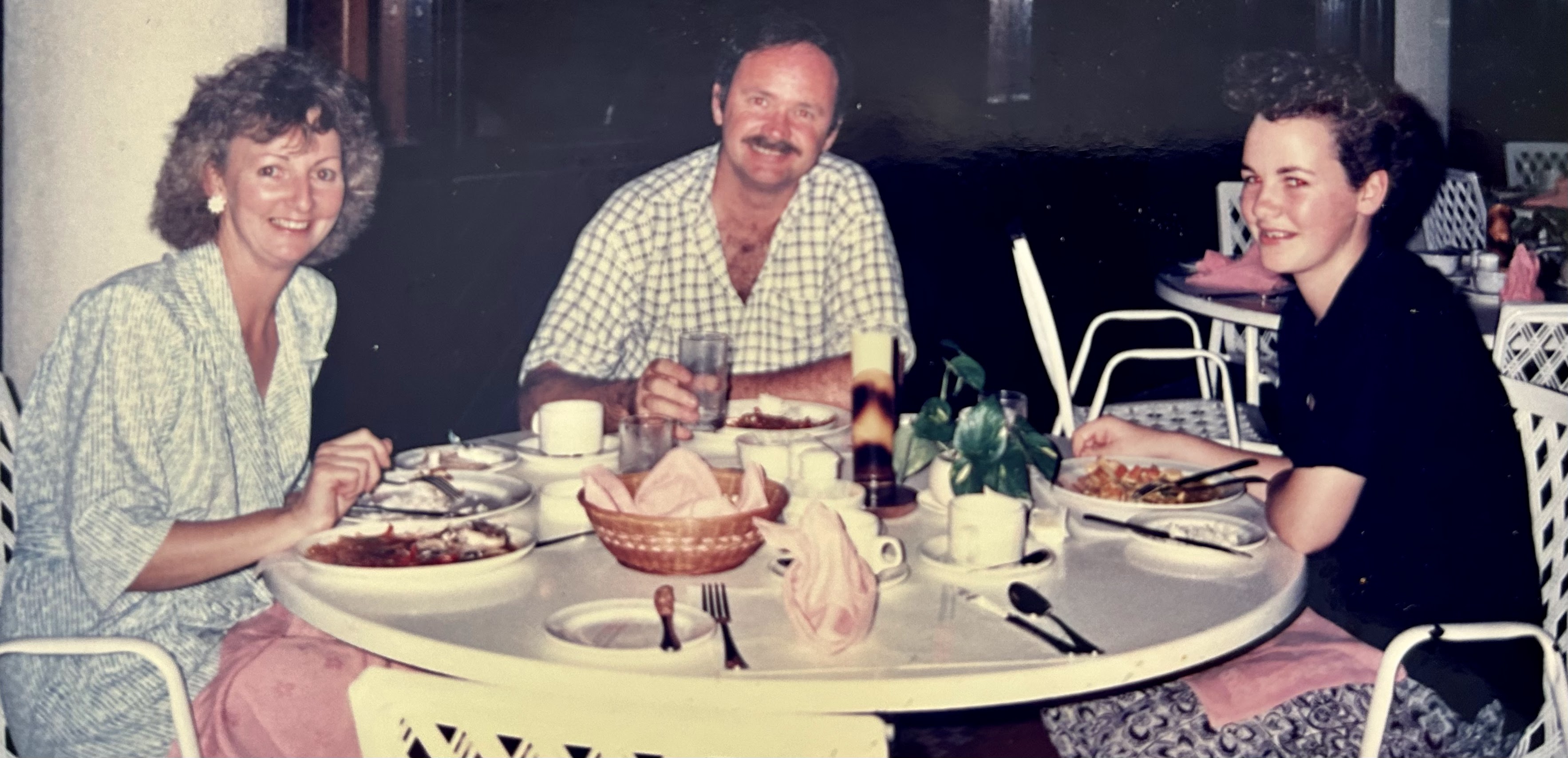
    The food at the resort was wonderful. Of course I always loved the desserts as my diary entry attests: Fabulous icecreams, sherbets and fresh fruit for desserts'. How's my 80s hair!!!! 

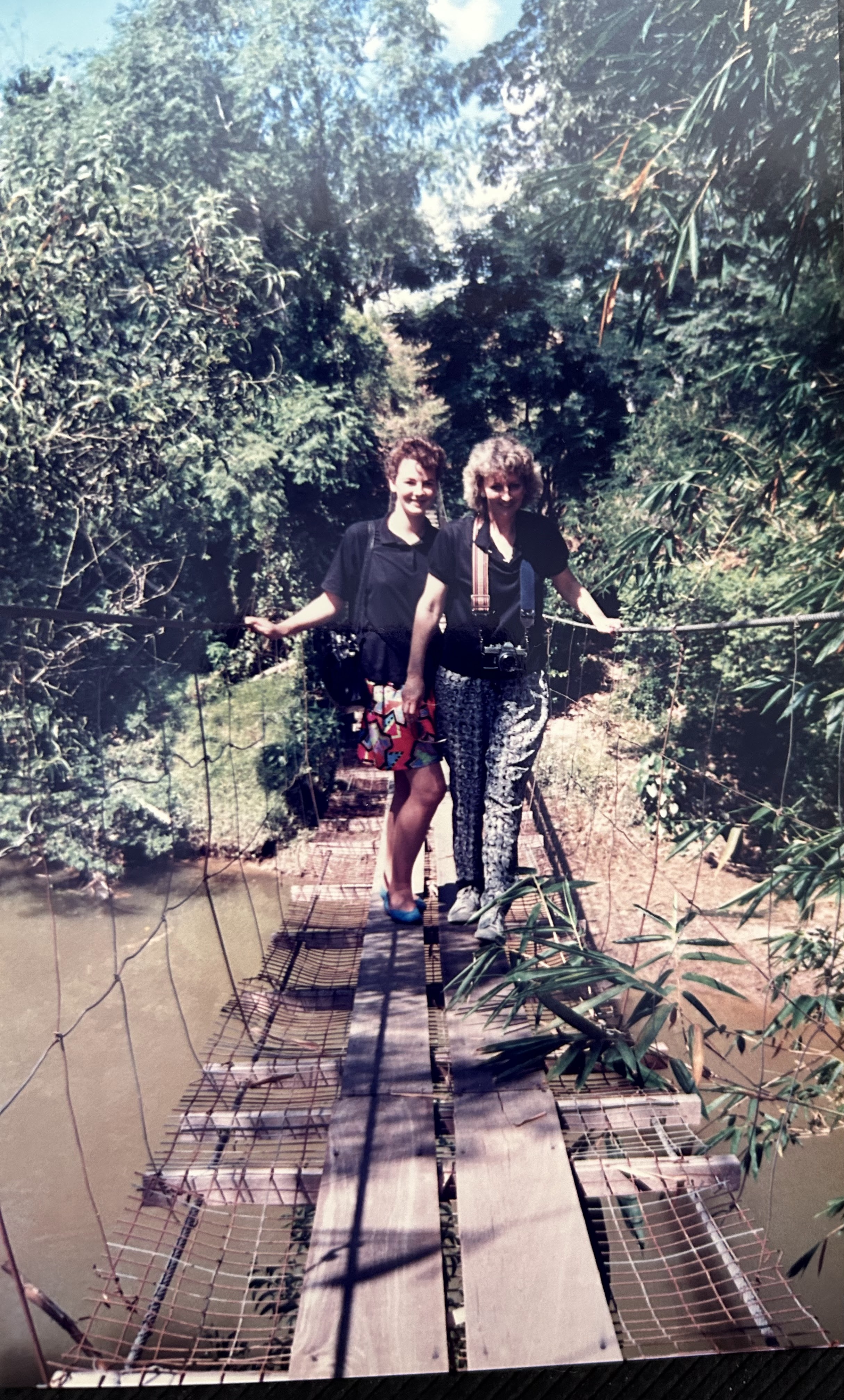
    The next day Steve went off to snorkel near Manakun Island, 10 minutes off the coast. Meanwhile, Kate and I caught the tour bus for a half-day tour that was included in our hotel stay. We visited a lot of places and indeed, for a hotel tour, it certainly kept our interest and we learnt so much. My diary records ' houses on stilts over the river, water buffalos swimming in the muddy water, farmers pushing buffalo-drawn ploughs, and all around, luxuriant green vegetation'.  We stopped at a suspension bridge which we walked across, swaying unsteadily. Water buffalo swimming below lazily eyed us.
    In the afternoon we all caught the boat to Gaya Island, part of the Tunku Abdul Rahman National Park 15 minutes away. We set off on one of the many trails through the jungle. I'm not one for humidity and the trail was a very steep climb and within five minutes we were sweating profusely and our legs were aching. I remember the millions of cicadas that whirled around us in a deafening hum while vividly coloured butterflies flitted in and out of the trees. We finally reached the highest point on the trail feeling a sense of accomplishment. Heading back we could hear monkeys grunting and swishing through the foliage but could not see them.  

    We do look pretty exhausted here.


    Kinabalu National Park

    The following day we visited Kinabalu National Park, two hours from the capital, It was a tiring but exciting day. The drive there revealed picturesque vistas at every turn, from little villages clinging precariously to mountain slopes, banana palms and bamboo in the green valleys below, to Mt Kinabalu looming ahead shrouded in clouds. We arrived at the park and headed for the start of the mountain walk - certainly not aiming to reach the top and check out the sunrise as many do! Instead, we gave ourselves two hours before we were to be picked up again. 
    Moist rain fell as we began. We passed a waterfall tumbling about 75 feet down to large boulders and stones.
    The track started to get steeper and our legs began to ache, though the vegetation growing by the side of the track - tiny orchids, mosses, vines, a profusion of ferns and the hard-to-spot pitcher plant - was a welcome distraction.  Gnarled tree roots snaked over the track, dark branches loomed overhead. On we went, humidity and effort wearing me out. Steve and Kate continued on for a while - while I rested! 

    Eventually they returned and we headed back to the park entrance and our driver.
    Poring Hot Springs
    We were headed for Poring Hot Springs, about 35kms away. The road, if you could call it that, consisted mostly of boulders. We bounced and tumbled on, past small villages with bamboo houses on stilts. (That evening as I was writing in my diary, I remembered the drive so vividly): 
    Goats lay in the middle of the road, cows ambled through the traffic, while geese, sheep, water buffalo and cats made up village life. Streetside markets were occupied by villagers selling vegetables. We continued our rough, roller-coaster ride through flooded river beds and up steep hillsides until finally we reached Poring near the village of Ranan. 

    Before we made use of the thermal springs, we took a trail through the steamy jungle to a magnificent waterfall and then visited a huge stone bat cave hidden among the vines. The bats darted in and out of the cave in an endless whirring flutter. We were certainly looking forward to the baths by now. Poring's thermal springs were used by the Japanese in World War II where they built baths for the men's recreational use. At the time of our visit the baths were still in use with huge taps pouring hot and cold water into the concrete tubs. All of this was set in beautiful gardens of exotic, brightly coloured  rhododendrons, flame trees, day lilies, frangipani and orchids. 


    We chose some tubs away from the main ones and finally managed to get the temperature of the water just right. Here we are feeling refreshed.  The springs themselves where the water was being piped from were behind us, steam and vapours rising continually from them. 

    Afterwards we dived into the rock pool, a crystal clear pool built around the rocks and surrounded by the garden - heavenly.
    Sandakan
    We flew to Sandakan on the east coast of Sabah (386 kms away) to visit the Sepilok Orangutan Sanctuary. This rehabilitation centre we were told ' provides a safe haven for orphaned and injured orangutans',  nurturing and training them to live in the wild and then releasing them back into the jungle. We walked slowly on a path through the jungle - and there we found them. Three young orangutans with reddish-brown fur and big appealing eyes. Two more swung through the trees to inspect us. One came straight for Steve's camera - we had been warned about this and had tried to keep our cameras close to our body. When the orangutan couldn't get it, he attached himself to Steve's arm, not in a threatening way, he was just being curious. 
    Others were now swinging and tumbling from vine to vine, crashing with loud crunching noises and surrounding us. It was a surreal and exciting experience. And because we were there before feeding time (when the crowded tour buses arrive) we were all alone.


    They especially liked Kate and took her hand, walking with her into the jungle. Everywhere she went, they would attach themselves to her until she would pick one up. It was a lovely experience for her as the photos show. (Knowing this couldn't happen today makes this a very special treat.)
     
    . 
    After all this excitement, we watched them being fed, then decided to do another jungle walk. It was very hot and steamy and we kept stopping to take deep breaths and to towel ourselves dry. We eventually climbed to a viewing platform. It was wonderful to see the vines, creepers and trees from a different angle, but I can't say I was sorry to return to the park headquarters.
    Sarawak
    We flew further south to Kuching, the capital of the state of Sarawak.  The following day we headed up the river to the Damai Beach resort. We had been booked here as part of a travel writers' deal for Steve, so we had a guided tour of the place and then were taken to a local village - Santibong- a small fishing community consisting of traditional stilt houses with leaf roofing. 

    Children were playing, goats and chickens grazed and people smiled and waved at us. A wedding ceremony had been held that morning and the villagers were celebrating with a huge meal under the trees. However, in the house of the head man, the bride and groom was preparing to eat their first meal together. And then... oh my goodness, we were invited to join them. Although we were strangers from a different country it is traditional to welcome us into their home and have us join the celebration to bring good luck to the couple. So, in we went in our jeans and t-shirts, feeling rather embarrassed. Seated around the walls were their special girl friends all in gorgeous dresses. They were shy and hid their faces from us yet kept sneaking intriguing looks at us. 
    The bride and groom then appeared in their traditional outfits and sat on the richly decorated carpet. Dishes were then set out on the floor before them: meats, rice, vegetables, pineapple, eggs - and finger bowls as the food is eaten by the right hand. The bride's grandmother served them then suddenly motioned to us. We moved forward and sat crosslegged with the bride and groom and the grandparents.The bride's mother for some reason was not included; in fact she was behind me. 
    We were given plates and a finger bowl. 

    I thought she was telling me not to take a photo, but no, she was inviting me to eat! 

    The bridegroom chatted away to Kate and asked about high school and where she was from. 
    I kept smiling and nodding at everyone, thinking how strange this was that we were sharing the bridal food. My diary noted: The village video tape was being operated and we suddenly became the star performers. In weeks to come they are going to see me stuffing my mouth with rice and nodding and smiling.  It was an experience I'll never forget. And I haven't. 

    The next day we were taken to Turtle Island where they raise young turtles to the size where they can survive. Kate was allowed to hold one in her hand. We visited the laboratory, did some snorkeling, swimming and walking around the island. A good day.


    Kuching
    The following day we returned to Kuching and explored the city.

    The city occupies both sides of the Sarawak River, with commercial businesses on one side and residential on the other.  We followed a walk that took us to a 100-year-old Chinese temple, an old colonial building called the Bishop's House, a park, a mosque, and the open markets which were  stacked with fresh fruit, vegetables, fish, meat and chickens. 
    Across the river we could see the large white stone building that was the palace of the last white Rajah of Sarawak, Charles Brooke.
    A final stop was to visit the museum which we thoroughly enjoyed.
    Up the Skrang
    I think the most memorable part of our trip was the boat ride up the Skrang River to an Iban longhouse where we stayed the night. All these years later, I still have the most vivid of memories - the 5-hour road trip over a tortuous, boulder-strewn 'road'; the fabulous trip upriver balanced precariously with our bags on the flat-bottomed dugout canoe with outboard motor; the longhouse and its friendly people; the steamy jungle and the 24-hour-long thunderstorm; the animals...
    The long boats used for travelling upriver. 

    Steve and Kate disembarking at the longhouse.
    My diary records our arrival: 'We climbed out of the canoe and waded over some rocks to reach the ladder - a very tall tree trunk cut into steps. Up we climbed to find ourselves in the longhouse 'village' - a cluster of rooms around a long wooden deck, its stilts rising steeply from the muddy soil, with animals housed below. 
    There were 23 families living here; daytime activities took place on the covered verandah which ran the full length of the longhouse. Off this verandah were the rooms belonging to the families. There was also a kitchen and storerooms. A wooden deck also ran the entire length of the longhouse open to the elements. Here is part of the outside decking that was used to store a range of items.

    I look at my photo album now and regret that I didn't take many photos.  No wide-shot of the longhouse, no animals, no families carrying on their everyday activities (weaving, woodcarving, cooking...)  I was more interested in talking (as best as we could) to the families and showing an interest in their way of life. As well, it was very humid and after a while heavy rain disrupted any outdoor activity making photography impossible. 
      
    In very sticky but fine weather the head man took us through the jungle and showed us how to use a blowpipe.

    But without much warning the sky opened and heavy rain started sheeting down. We scuttled back to the longhouse. The thunderstorm was to continue for the next 24 hours we were there. 
    The lovely families in the longhouse dressed in their ceremonial costumes for us.

    They put on a fabulous concert of music and dance ...

    .. and in which were expected to good-naturedly participate. Well, Kate and Steve did, to much applause.


    I only include this ghastly photo of our longhouse adventure because it makes me laugh. 
    I was given the hat when it started to rain and thunder and they thought we looked funny. I guess we do!

    After dinner and the concert, the whole 'village' sat in their family groups around small lamps. Mattresses covered with mosquito netting were put out on the verandah for us as the rooms were still very hot. We slept fitfully that night as the animals below us never stopped grunting, growling, barking and squealing.  At 3:00am the rooster began.......... 
    Homeward bound
    The next day we retraced our trip upriver and over the rocky road back to Kuching. 
    And then to Singapore and then finally Kuala Lumpur. A flight delay to Perth had us staying overnight courtesy of the airline so we spent a few hours in the largest shopping mall browsing and buying.

    My diary eloquently records: It was a great trip. Apart from the humidity. 

    ************************