Tuesday, 15 March 2022

Escape to the Coorong

'The Coorong is spirit- peace of isolation; regeneration of solitude; therapy of loneliness. Spirit that man desperately needs'. 

So wrote South Australian author Colin Thiele fifty years ago in 1972 - and his sentiments are just as fitting today. Looking forward to capturing that sense of isolation and peace, we decided to escape the neighbourhood and head east for the day, ignoring the observation of French explorer Nicolas Baudin, who in 1802 declared the area ' wretched and unpleasant'.  It's a couple of hundred kms from home so we set off early in joyful spirits.

In geographical terms, the Coorong is a huge saline lagoon 140kms long beginning a little east of Goolwa where the Murray River enters the sea and stretching all the way to the coastal town of Kingston in the far south-east of the state; the lagoon is separated from the Southern Ocean by a long (very long) neck of sand dunes and I guess that at first sight it does look a little underwhelming. However, Colin Thiele evoked a much more evocative  sense of place in his 1964 novel Storm Boy. 

“Storm Boy lived between the Coorong and the sea. His home was the long, long snout of sandhill and scrub that curves away south-eastwards from the Murray Mouth. A wild strip it is, windswept and tussocky, with the flat shallow water of the South Australian Coorong on one side and the endless slam of the Southern Ocean on the other.”

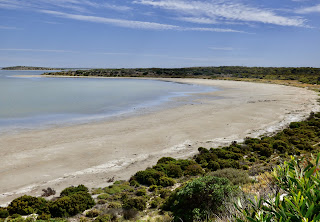
This beautiful coastal wilderness is home to many migratory birds and waterfowl, including my favourite - pelicans. It is also hugely significant to the Ngarrindjeri people who have called this their home for thousands of years. From the ever-shifting steep dunes, the landscape is flat and consists of lagoons, narrow waterways, small lakes, salt pans, and native flora that includes scrubby tussocks, spinifex, mallee, tea trees and a range of saltmarsh species such as samphire. This wetlands ecosystem is, rightly, a protected area. This photo is a good example, showing dunes (although these have been heavily vegetated), a lagoon and typical plants.


We had previously visited some of the Coorong way back in 1998 when we did a guided tour of the far south-east portion, and again in 2016 when we did a cruise from Goolwa where the lagoon begins and explored the sand dunes. This time, we were doing, as I termed it, 'the middle bit'.    

The start of our Coorong escape is the lovely lakeside town of Meningie approximately 150kms from Encounter Bay. It's quite an adventure to even get there as we first have to navigate around Lake Alexandrina into which the Murray River finally drains. It's a mighty obstacle and it takes ages to drive along the shoreline. At the tip of the lake is the small town of Wellington where we have to take the car ferry to cross the Murray and continue on our journey. I love this tiny trip as the cable pulls us gently across the stretch of river. Then it's 50 kms to Meningie.

Meningie is called 'The Gateway to the Coorong'. It nestles on the freshwater Lake Albert (a smaller lake next to Lake Alexandrina that is also fed by the Murray) and is a bustling town with all the amenities needed - including a top notch bakery where we refuelled with a hot chocolate and coffee and suitable sugary treats for each of us. The lovely lady at the Information Centre supplied us with maps, brochures and information on spots we wouldn't have otherwise known about. This map shows Lake Alexandrina, Meningie and Salt Creek. 


We were aiming for Salt Creek, a tiny settlement where we had planned our first walk, but stopping off at places along the way that had been suggested to us.  I loved the drive. It was big sky country, with acres of grazing land to the left and the scrubby coastal vegetation to the right, all of it encased by the huge arc of blue sky stretching forever overhead. I was amazed at the number of pastoral properties we passed - nothing more than a gate, a name on a sign, and a lonely drive disappearing into the far distance. But pastoralists had first settled here in the 1840s, establishing large holdings on which to graze their cattle and sheep and grow crops. Some were successful but many encountered immense struggles and hardship in this isolated and unproductive-looking area. I can only imagine what the Ngarrindjeri peoples thought as the environment changed considerably to cater for this new endeavour. I wondered how many of these properties I was seeing were the original landholdings. 

Our first stop was Parnka Point,  a small spit of land jutting through the northern lagoon with road access. Here we could see the lagoon on both sides. It was peaceful. The landscape stretched before us. Not a soul in sight.



We continued on until Salt Creek came into view.
All that was here was a caravan serving food and drink to travellers and a replica of the original oil rig that commemorates a mining industry that never was. The information panel revealed an interesting history: A rumour of an oil discovery began when what looked like oil was found. The Coorong Oil Company was formed and several wells were drilled. However,  no oil was ever forthcoming. Later, the 'oil' that was supposed to have been discovered was found to be a natural substance derived from algae; the material was later named Coorongite, as a tribute to where it was first found.  
A little further on was a small motel.  

We had elected to do the 3.5kms loop walk around the lake - the Ngrugie Ngoppun Walk, 'good walk' in the Ngarrindjeri language.  We walked through an overgrown thicket, a theatrical warm-up to what lay beyond.


Which was a vast landscape of reeds and marsh plants with the lake in the near distance surrounded by thick shrubs and trees. 

Wild, beautiful, unspoilt are clichés that sprang to mind. The track was firm and made for an easy stroll.

This was supposed to be a birdwatchers' haven but, although we were constantly hearing the tweets, warbles and chirps of different types of birds, we didn't actually see any. We wandered on, a gentle warmth from the sun, an incredibly blue sky with wispy clouds and the glistening lake.


This is where I spotted the tribute plaque to Colin Thiele. 


We rounded the lake and crossed the water via the concrete walkway, luckily spotting the sign that indicated the walk. On we went. I loved this field of plants that had obviously adapted well to the harsh, salty conditions. [Note: Oops. I have since been informed by my environmental friend BB that this is the dastardly sea spurge that is a weed devastating the sand dunes in southern Australia, but it is difficult to control.] 
The signs were now getting more difficult to find and the track became rockier. 
We rested for a spell, taking in the views over the flat landscape...

... and taking photos.


And then... disaster. No more signs. No more well-trodden track. No cleared spaces. No sense of where we were.  The track was labelled 'a loop' so we thought we'd have returned close-ish to the place where we'd started. But no. We were on the other side of the lake. We struggled on a bit more until we could see in the distance cars going along the highway- a very good sign. Steve decided that we should take the shortest route to the road across the salt pan  (probably very non-environmental), but as good a solution as any. Off we went.


A bit of reed bashing.

And finally, the road.

We read later that 'The track is well signposted up to a point and then becomes indistinct'. You could say that again. Annoyed but thankful for our survival, we hopped in the car and headed for the next destination: Chinaman's Well.  

When gold was discovered in Victoria in the 1850s hundreds of Chinese made their way to the goldfields; many landed in South Australia to avoid paying the tax imposed by the Victorians for people entering their colony. This meant a hard slog across inhospitable country with little water. The ever-resourceful Chinese built a number of wells on the way so they could source fresh water along their route. One of these wells has been preserved. There's a small loop track with interpretive signs along the way, bringing the history of the site vividly alive. First up was a sign explaining how they carved limestone from a quarry to  construct the well. There's a walkway leading to a shallow depression that clearly shows where the lid of the well was carved. 


The signs helped us visualise the difficulties the Chinese faced. 


And here it is. 

Steve dug out some photos from our previous trip which proved to be rather interesting in that they show how different the presentation of the well is now. Then it was surrounded by a protective wire cage and we could walk right up to it. Here are a couple of photos from that time. 


Our last stop was on the homeward journey where we visited Jack Point where you can view the huge pelican population.  You can see the viewing platform in the distance. We didn't take the walk there (I think we were just too tired) but saw flocks of pelicans flying overhead - a wonderful sight.
It was my last chance to capture the essence of the Coorong. 


A fabulous day out.  

Sunday, 23 January 2022

Back to the Maldives

It's October 1985 and Steve, inspired by a colleague's recent recommendation, has brought me a travel brochure featuring a handful of resorts in the Maldives. 'It looks fabulous', he says. 'What do you think? My friend says the brochure's not lying. There are fantastic coral reefs, terrific snorkelling, white sand, palm trees, clear waters and very friendly people. And it's not overrun with tourists. And it's pronounced 'Mall-divs'. 


Hmmm. The brochure photos certainly looked great. I wasn't sure exactly where the Maldives were; they were definitely not on everyone's radar at this time as Bali, Fiji, and Vanuatu were the go-to destinations that attracted Australian tourists. In fact, the brochure indicated that tourism in the Maldives was very much in its infancy with only a few islands having been developed for this purpose. That sounded just the kind of thing we liked. Some of these islands were operated by Germans who ran diving schools, attracting mostly Europeans. 

The brochure map showed hundreds of tiny islands surrounded by coral reefs - miniscule pinpricks on the paper in the vast Indian Ocean. The nearest landmass was the southern tip of India and Sri Lanka to the north-east which gave me a better idea of where these islands were. Africa to the west was a million miles away - or so it seemed.

We planned to go in January during the school holidays, which coincided with the islands' dry season.  We picked out two islands to visit. Getting there via Singapore would be easy, and we added a few days in Sri Lanka because it was only a short plane trip away. The very names of the islands we had chosen -Ziyaaraifushi and Embudu-finolu - promised an exotic adventure. 

It was only a 10-day holiday but it was the first overseas trip we had taken together. As it turned out, the holiday was so successful it was the start of 35 years of travelling the world for us.

The other day I dug out my old photo album and diary. I was not a great photographer then and the camera I had was small and automatic so I couldn't adjust for light etc.  And unlike today with my digital camera, I didn't take a lot of photos. Of course cameras used film then, so today the 35-year-old photos look a bit washed out and grainy. However, I managed to capture some shots that summed up the gorgeous scenery, especially the sunsets. 

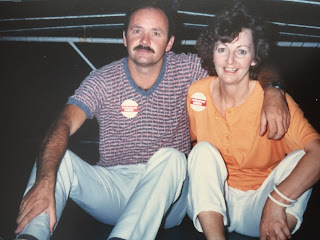
But I'm getting ahead of myself. The journey to our island paradise did not go according to plan. I remember arriving at the airport on the main island of Malé at close on to midnight and finding no-one to greet us as arranged. Oops. Was this a disaster in the making? Fortunately, a man appeared who told us it was far too late to attempt the trip to faraway Ziyaaraifushi and we would be taken by dhoni (a slow water taxi) to Lohifushi, a closer island run by the same company. Disaster averted, and at least we were going to get a glimpse of another island. We boarded the dhoni which headed out into the extremely dark ocean with only the star-studded sky above providing light. It all felt rather unreal. This photo shows that I was rather excited! Steve just looks tired. By our clocks it was about 2:00am.
It took two and a half hours to arrive, by which time we were thoroughly exhausted and fell asleep within five minutes of being shown our room. The next morning we woke feeling refreshed but on an island where we weren't supposed to be. Luckily we had time for a quick tour. My diary records: The perfumed flowers from the tall trees gave off a heady scent as we walked along the narrow pathway around the island. Coconut trees. Buzzing insects. Scuttling lizards. A cooling breeze. At the far end, surf crashed against the rocky shore. I definitely felt I was on a tropical island.

And then we were on our way again, this time in a speed launch. What fun it was to watch the boat cleverly navigate coral reefs, seeing islands come and go as we sped along, being lightly drenched as white spray shot over us. The small boat was also full of bananas and chickens! Even zooming across the water it took one and a half hours to reach Ziyaaraifushi

We were enchanted. Our hut was right on the water.

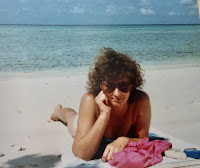
In those days I sunbathed with nary a thought as to what the fierce rays were doing to my skin, so spent many hours lying on 'our' beach and wading into the calm, clear water to lazily swim a few strokes. 

It was wonderful. You can see how tanned we were. 

'This is the life' I recorded in my diary.

What stands out for me now are the memories of the sunsets; the water that merged with the sky in a pale misty haze in the early hours of the morning, turning from lavender to pink then pale orange as the sun rose; the underwater world of coral and brightly coloured fish; the happy, courteous and helpful staff. The meals were simple but delicious - lots of fish, meat stews, curries and rice, vegetables, salads and fruit.  The generator stopped mid-afternoon so there was no fan or electricity for a while, but we learnt to put up with it and rest for a couple of hours or go swimming.


As I said, the snorkelling was fantastic, but I have to say I was a complete novice - I'd never snorkelled before. I was converted in two seconds! The water was lovely and warm, no waves and the reef near our hut was only a few metres below the surface. It was an underwater paradise and anything I write here will sound like a travel brochure. I'll go to my diary which records my thoughts immediately after my first snorkelling experience.

Snorkelling was magnificent. Brilliantly coloured fish of all shapes swimming in front of my eyes - tiny aquamarine fish, larger blue with yellow stripes, orange with black markings, miniscule grey ones, small schools of silver fish.  The coral was vividly coloured and, to me, resembled a landscaped garden. Yellow, pink, blue and purple shapes, some branches, others rounded humps. I swam over coral valleys that suddenly dipped into slightly deeper water. What an experience. One I will never forget. 

And I never have. I recorded another three snorkelling trips. In each one I sound more excited and entranced.  The following photo is one Steve took with his small underwater camera. And I've cheated and included a brochure photo  of some fish because it shows exactly what I saw.


The intrepid snorkeller.

And so our time on Ziyaaraifushi passed in an endless round of lazy mornings, swims, snorkelling, scrumptious lunches and dinner, a crab race one night and another memorable evening when fishermen from an island 'only three hours away' we were told, came to play their music. Back to the diary to capture this moment.

It was exhilarating to sit on our deckchairs in the warm night air listening to the pounding beat of the native drums and cymbals and chanting. Every now and again some would break into a dance. Some of the younger ones really went wild, doing back-flips and somersaults. We finally wandered back to our hut with the sounds of the music still throbbing through the island. 

But it wasn't over yet and I loved my next paragraph.

We waded into the water which was still warm and perfectly still - with the stars overhead- wonderful. Millions of tiny sand crabs were scuttling across the sand and larger rock crabs were scrambling over the jagged rocks on the shore.  It was the end of a perfect day. 

After our Sri Lanka sojourn, we flew to Malé and caught a launch to Embudu-Finolu. Choppy seas and a rather unpleasant trip of a couple of hours. This island was much smaller than Ziyaaraifushi and there was only a handful of huts. I'd stuck a paragraph from the brochure into my album. It says: Embudu-Finolu is a new resort only 20 minutes from the airport. It is very intimate with only 20 duplex-styled units scattered around the island. An excellent "get away from it all" resort.'

In all I only took one photo of this island!   


We met a couple from Sydney who were officers with the NSW police. I've included this photo as it makes me wonder what their lives have been like. They sounded so adventurous as they told us they had just come from exploring India, Tibet and Sri Lanka.       

It was soon time for us to leave. Little did I know then that my future travels would also include many adventures. 

Fast forward to today. I wondered how the islands we had visited had fared over the years, now that the Maldives are a very popular tourist destination. What I discovered first was that the islands are one of the lowest lying in the world, making climate change and rising sea levels a very real problem for them. This fact of course was never even hinted at back in the 1980s. 

During the 1990s the islands began to be further developed, until today the resorts, numbering almost 100, could be in any tropical location. The brochures extoll the physical features of white sands, palm trees, clear waters and spectacular sunsets as our 1985 brochure did. But then we read about over-water bungalows, top-class restaurants, bars, infinity pools, TVs, water sports.... all the amenities that tourists seem to require nowadays. Disappointingly, I rarely read anything about the Maldivian culture. 

I discovered that the resort on Ziyaaraifushi was sold in the late 1990s. Then, in 2015, it was completely demolished and a new one, under the name of Summer Island Resort Ziyaaraifushi was built. Luckily, the website says it is 'owned and managed locally'. This is the photo from their website. How utterly different from our experience.

Unfortunately, there have been two very severe coral bleaching episodes. After the one in 1998 experiments were undertaken building artificial reefs in deeper waters and transplanting coral onto them. Sadly, another bleaching took place in 2016 and all the coral transplants died. However, there is cause for optimism. I read a 2018 report that described new technology in the form of a 3-D printed reef developed in Melbourne that had been installed offshore at the resort. 

Photo from Summer Island Resort website.

The developers and islanders hope that this concrete and ceramic reef will create a new coral reef ecosystem that will enable coral reefs to survive a warming climate. I certainly hope it succeeds as it is those long ago memories of the wonderful snorkelling here that I recall so vividly.  


Saturday, 25 December 2021

It's Christmas time

Christmas was a very low key affair this year. We began on Christmas Eve when we Facetimed Kate and Kim. They announced that they had already opened the hamper we sent and urged us to open their present to us. Of course I protested that you never open presents before Christmas Day but I was overruled and so we tackled the very large cardboard box they had sent. Oh my goodness!!!!!! Let's just say our drinks trolley is groaning under the weight.  We can't wait to try out new cocktails.

To celebrate, I made a Pisco Sour... which Steve swiftly devoured.


I dug out our supply of Christmas songs and popped them into the player. While it wasn't a warm night, there was certainly no snow, no sound of any jingling bells and not a snowman in sight.  And while I was listening to these songs of the northern hemisphere, it brought to mind the carols we sang in primary school - way back in the 50s. The ones I remember mentioned hot winds and dry wheat fields and bellbirds singing in fern gullies - much more Australian and relevant, I thought.

These carols seem to have vanished as I never hear them now. I don't listen to the radio anymore so perhaps they are played. Anyway I did a bit of research and found out who wrote them. They were two people working at the ABC. Together they wrote a number of Australian Christmas carols beginning in 1948. They were William James, the musical director and James Wheeler, a scriptwriter. The ones I remember and can still sing include 'The Carol of the Birds' (Out on the plains the brolgas are dancing, Lifting their feet like war horses prancing...'; 'The Three Drovers' (The black swans flew across the sky, the wild dog called across the plain') and my favourite of all 'The North Wind':

The north wind is tossing the leaves
The red dust is over the town
The sparrows are under the eaves
And the grass in the paddock is brown
As we lift up our voices and sing
To the Christ child the Heavenly king.

It was all so much better bellowing out about the hot wind blowing over the paddocks than riding in the
snow on a sleigh. All so evocative and much more appropriate.

Our Christmas Day was relaxed and happy with present opening and texting to friends who had given me such thoughtful gifts. My dear sister supplied me with healthy spreads (can't wait to try out the beetroot and chickpea one) and a book of walks in the Adelaide Hills, something to definitely look forward to. Sharon helpfully supplied me with much-needed beauty aids. Steve gave me this gorgeous book which made me yearn to visit again. The photographs are beautiful.
He was amused with this 1,000 piece jigsaw of old Australian stamps I found at Australia Post.

For breakfast we had scrambled eggs and my traditional cranberry muffins, made each year since Kate introduced them to me about 10 years ago, and which really are yummy. Lunch was delicious with crayfish, prawns and salads.  We even had the first tomato from Steve's crop.


The evening meal .... well, we didn't feel like much, and made do with a slice of ham and the salad leftovers.  The end to a lovely Christmas and - for a whole year - no more Christmas carols, crayfish, cards and carbs!