Monday, 25 June 2018

'Remembrances of Things Past'

We set off in high spirits on a glorious sunshiny day to explore Old Tailem Town, a privately owned pioneer village around 120 kms north-east of Encounter Bay, just past the town of Tailem Bend. Our excursion was organised by Steve's photography group (South Coast Camera Club) and 20 enthusiasts turned up. We were lucky in that friends Petra and Gary drove us, so we were well and truly relaxed by the time we arrived.

I didn't really know what to expect but it turned out to be a fascinating place, and all the better for being a bit low-key and unpretentious. The village was established in 1982 by one family. It's laid out like a regular town with shops and businesses lining the streets. There's also a school, a church and cemetery, a post office, doctor and dentist surgeries, a dance hall and a cinema. Many of the buildings were transported to the site from various places around South Australia with most dating from the 1890s; a ticket office is the oldest at 1870 and the school was originally built in 1881. The buildings are stocked with original products, furniture, items and artefacts. Some have mannequins posed and dressed in the period which add a human touch to the setting, and a bit of humour, too.

Here is a typical street scene.
And as well as the sedate town businesses, there was a car graveyard that provided plenty of opportunities for the photographers, as well as loads of old farm equipment, fire engines, boats and even a dozen train carriages. Here is a brief overview of what we saw.


Who knew there were so many styles of barbed wire!
In the barbed wire and fence museum this was one of about 10 such displays boards.  

A Coolgardie safe hanging on a verandah looking just like the one my Gran had.
Hmm...not sure I'd buy one of these.

We loved wandering around. The whole enterprise is a tribute to the hard-working Squires family. It must be an enormous job to keep the already old buildings from further decay and to ensure the 'shops' maintain a semblance of order and cleanliness.


Maybe a gardener is needed.

I loved the use of mannequins in the post office...
... the doctor's surgery ...
 ... the mortuary
... the hotel.

In the Salvation Army Citadel I discovered Sergeant Sarah Brown (lovers of Guys and Dolls will know who I mean).


Sadly, she didn't rattle her tambourine and sing!


I noticed lots of old bikes here and there as well as a bike shop, so here are some photos as a tribute to my cycle-loving son-in-law Kim. Not sure they would make the Tour De France this year.


Steve was hard at work, too.


If you're getting sick of old stuff, here are some close ups of the chooks I spotted.


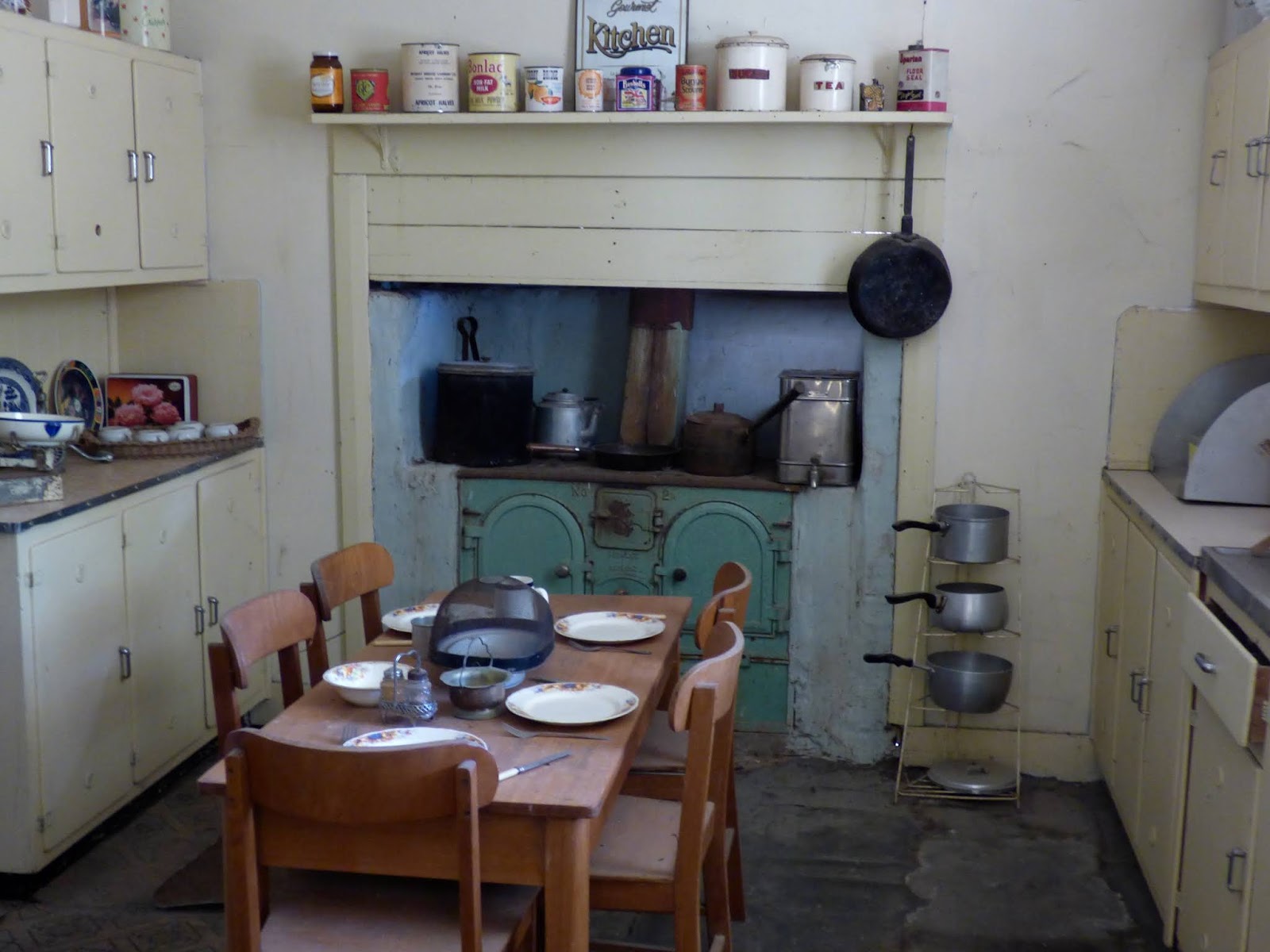
Now back to some interiors, all evoking memories of the past.


I've included this next photo because I have always liked the representation of Aboriginal people on the plates and cups and saucers that were extremely popular in the 1950s. I know they were cheesy but I never thought them disrespectful although I suppose the Aboriginal people may not have liked them.  This was displayed on a shelf in a dining room in the 'hotel'.
The patina of rust and old age caught my eye on a number of occasions.


 We wandered into the cinema where World War II newsreels were playing. In the foyer were film posters. Steve and I love this 1958 classic 'horror' movie; it was Steve McQueen's first role and you can see that he is listed as 'Steven' here.  A young Burt Bacharach wrote the title song.
I am going way off piste here in my blog but I can't resist listing the lyrics.
Beware of the Blob. It creeps
And leaps and glides and slides
Across the floor
Right through the door
And all around the wall
A splotch, a blotch
Be careful of the Blob.


In the school room, ink wells brought back lots of memories of my early schooldays. I even remember ink monitors who had to fill the inkwells on our desk every morning.
A framed set of rules for teachers made me thankful I taught in a more enlightened era.
Rule 6: Women teachers who marry will be dismissed.
Rule 7: Every teacher should lay aside from their pay a goodly sum of his earnings for his benefit during his declining years so that he will not be a burden on society. 
Rule 8: Any teacher who smokes, uses liquor, frequents pool or public halls will give reason to suspect his intentions, worth, honesty and integrity.

I loved this great example of 'make do and mend'.
And I quite like the results when I tried to be a bit creative.


And I'll finish up with a few of the photos Steve took.


 And so we say farewell to Old Tailem Town... an exhausting but successful photo outing that certainly provided me with 'remembrances of things past'.

Monday, 18 June 2018

Someone thinks they can write better than Agatha.

Enough I say! I have recently watched two television series based on Agatha Christie's stories: Ordeal by Innocence and Witness for the Prosecution.

For some reason scriptwriter Sarah Phelps thought she could do better than Agatha and in both cases rewrote large parts of the stories, so much so that in Ordeal By Innocence all that is left is the actual names of the characters. The plot line changes, the characters' backgrounds change, the character of the characters change, situations are invented, and to top it all, the murderer is completely different. It is not the same story at all, and yet is promoted under the banner of an Agatha Christie story.


I was alerted to all of this by my bibliophile friend BB who had memories of a different story entirely. I immediately reread the book to see if she was right, as it has been many years since I last read it.  And indeed it was so. In interviews, screenwriter Phelps said that she wanted to make it more modern and to be different because she reckoned a lot of people knew how it ended. (Though I wonder how many young viewers have read the book; even Phelps admits that she hadn't read any Christie before beginning these adaptation projects.)  'I don't give a bollocks about people saying it has to be pure. No it doesn't. If you want a pure adaptation, go and get someone else to do it', she said.

I love the response from a purist who, like me, can't understand the wholesale changes that were made: 'Why doesn't she write her own books if she thinks she can do better than someone who's sold millions of books. '

In a little defence for Phelps, I know that Christie often changed her own work for different media as she knew what would work better in a play than a novel. It is perhaps not so well known that she completely wrote Hercule Poirot out of a couple of her stories and substituted him with other characters when she adapted them for plays or simply rewrote them later.

And of course she's not the first to have a go at invention: a 2007 adaptation of Ordeal By Innocence popped Miss Marple into the plot!!!!

Moving on to the recent Witness for the Prosecution adaptation we also find a different ending to the one in Christie's original 1925 short story. But here the water gets murky, because Christie herself didn't like her ending and changed it in 1953 when she adapted her own story into a play.  But the recent television series, while using the original ending, then added to it with another twist - evidently, so a review said, to make it 'more emotional and give a greater depth and contemporary resonance'.

Film poster for the movie adaptation (Wikipedia)
In a similar vein, the recent French adaptations of Christie stories veer way off course, but it is openly acknowledged that these are only loosely based on Christie stories. I actually enjoyed the French flavour of these presentations; they are definitely in the Christie spirit but have no intention of being anything else.

It seems that everywhere, producers wish to cash in on the Christie name but want to bring her stories into a more modern era where audiences appear to demand more depth, insight and familiarity with modern thinking. Indeed, the latest film version of Murder on the Orient Express was criticised for not adding anything new to it! If that is so, then why not leave Agatha where she belongs and let other writers have a go at inventing their own 21st century murder mysteries.

To my way of thinking Agatha Christie knew a lot about those universal passions that all murders hang on - greed, money, vengeance, love - and those haven't changed one jot.

Thursday, 17 May 2018

Elizabeth Gould: wife, mother, artist

Who remembers the Gould League? John Gould was an English ornothologist who came to Australia in the 1830s to collect and identify Australian birds. To commemorate his work, the Gould League was established to promote an interest in birds. By the 1950s when I was in primary school it was concerned with environmental education, and all schools were given material and encouragement to study the local environment. I can remember having a Gould League badge and a calendar with bird pictures. I wonder if anyone remembers anything else?

Why this memory arose is because I've just read an account of Gould's wife Elizabeth, who was an artist in her own right and illustrated hundreds of his collections, though she was eclipsed by his fame, died an early death and was thereafter relegated to a footnote in history. The book is called The Birdman's Wife by Melissa Ashley and seeks to remedy this. It's one of those books that I refer to as 'rescuing women from obscurity'.

Elizabeth has always remained a shadowy figure and not a lot is known about her. The book is a fictional account of her short life (she died when she was 37).
Source: Wikipedia
The couple travelled extensively in Australia from 1838 to 1840 during which John Gould collected bird specimens and subsequently published his monumental work Birds of Australia.
Although the author has done a lot of research and there is a good sense of the times, I never like fictional accounts. Why not write a decent biography?

So while I enjoyed much of the narrative (and learnt that a young Edward Lear was an early friend) there seemed to be a lot of padding with descriptions of birds, the problem with being a woman artist, and the actions of her impetuous husband. But the poor woman had to run a household, give birth to eight children, as well as concentrate on producing illustrations at breakneck speed for her demanding husband. And to top it all, after she died, her illustrations were made into lithographs and bore the name of the lithographer! So it's good that she has finally been given this recognition. And it's a gorgeous cover, isn't it!