Thursday, 8 September 2016

Beyond Beacon 19

We set off to follow a friend's directions for a walk near Goolwa. We were instructed, rather like spies in a World War II movie, to 'Go to Beacon 19'. We discovered that this was the name of the last boat ramp on the River Murray before the river reaches the great Southern Ocean. We drove alongside the Murray ...


... past a sign that told us we were in the Coorong National Park, until we came to a sign that comfortingly said 'Beacon 19 Road'. This ended at an enormous parking area that no doubt is filled to capacity come summer.

We spotted the walking track and set off.


The boardwalk continued all the way to the ocean, making it a very easy 20-minute walk. 

Lots of spring flowers and plants were out.


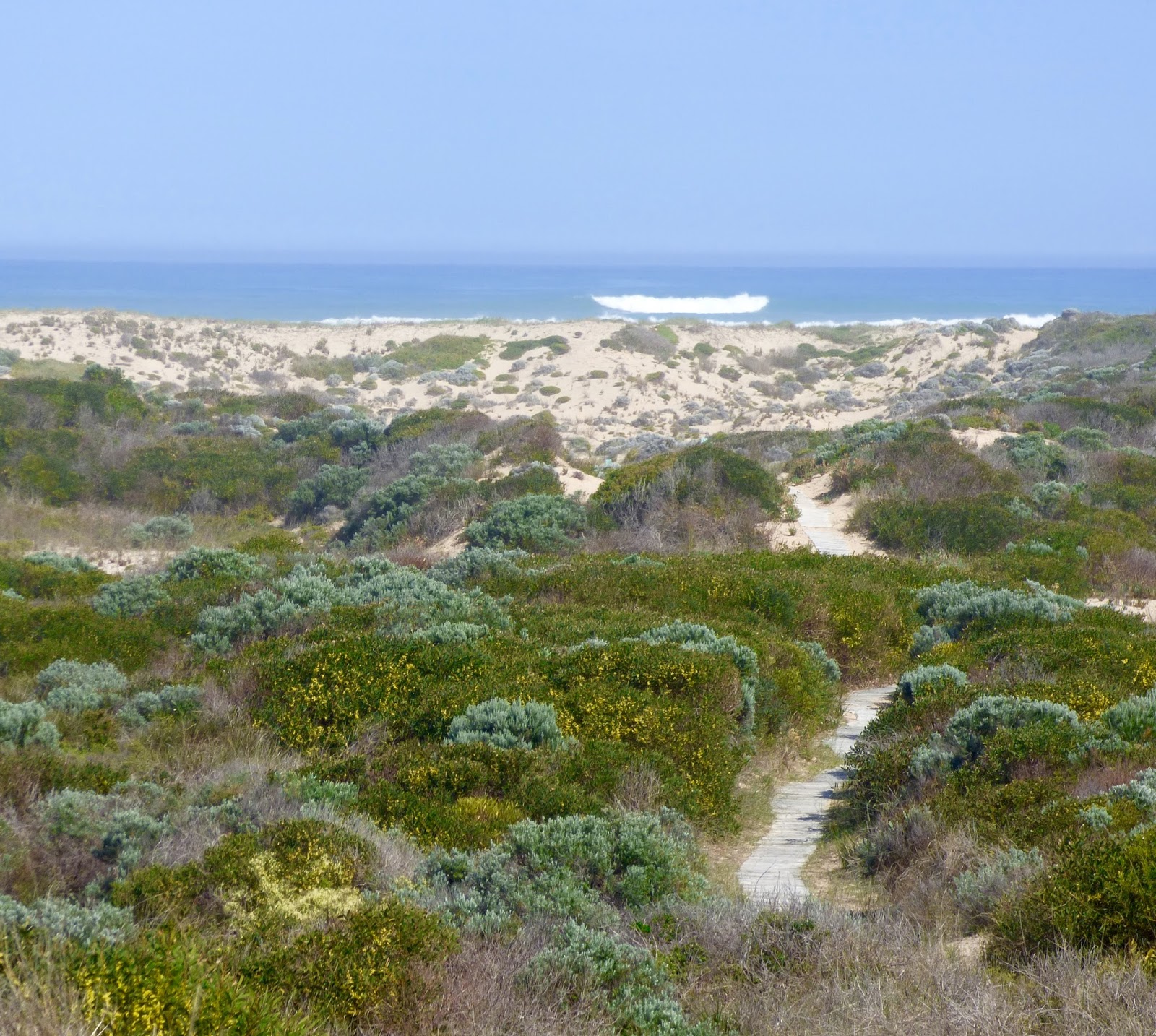
The walk gradually wound  uphill over sand dunes. 


We were nearly there. Only a few more dunes and we would be at the Southern Ocean.


And there it was.
 We scrambled down the last bit of boardwalk and the ocean lay in front of us. The splash of the waves endlessly rolling in was the only sound we could hear. There was not another soul to be seen.

The golden sand stretched as far as the eye could see to the right...


...and to the left. The sand is so hard that cars are allowed to drive on the beach. This was the only sign of anyone else we saw the whole time we were there, and they were gone in the blink of an eye.

After a stroll along the shore we settled in to have our picnic sandwiches.
It was sublime: munching on our sandwiches, listening to the surging surf, gazing at the ever-changing clouds, watching the seabirds hop along the shoreline, and simply soaking up the sense of peace.

I got out my camera to capture the pied oystercatchers that were seeking their own lunch in the shallows.


It was time to go.


We passed one of several Aboriginal middens.


At the car park, we could see the sun glinting off the River Murray in the late afternoon light.
It was the end to another lovely walk on the Fleurieu Peninsula.


Tuesday, 6 September 2016

Spring fever

Only six days into spring and I already feel light-headed and well, springy. The sun is out, blossoms are exploding and the urge to potter in the garden is overwhelming.

The front garden is all pebbles and drought-loving plants.
The kangaroo paw 'Bush Fury' is looking good.

The cordylines seem to be thriving.

Near the red front door I have positioned three smallish plants (a dwarf agapanthus, a succulent, and a Japanese box), all of which are growing well.


I have been blessed with lovely gardening friends. One gave me this gorgeous orchid. Its buds refused to do anything for 2 months until last week, lo and behold, a burst of spring fever and I have four delectable flowers. The blue pot was given to me by another friend. How lucky I am!

 I'm a sucker for red geraniums and this one is very obliging.


The date palm was buffeted by the strong winter winds but has withstood the onslaught and is looking good. It's in the pot Kate and Kim gave me.

I had a huge cumquat tree in my last garden and regularly made cumquat jam which always turned out well. So this is my latest purchase. For those of you who like to know such things it is Cumquat Nagami which produces, so the label tells me, 'delicious teardrop-shaped fruit in the winter'. We shall see. It's only just been planted so needs to settle in.
The pot is another gift from my friend Di.

Plants are in full bloom everywhere I look:
The rich purple of the statice

Pale pink diosma blooms against the green foliage

The ever-reliable alyssum

This next photo is cheating. I love the smell of freesias. However, I didn't plant any bulbs this year so had to resort to a purchase. I am definitely putting them in next year.


We have just ordered sun screens for the courtyard, to go between the posts on the western side. This should effectively shield the area from the heavy winter rain (to a degree) and allow me to recline on the sofa in summer without the glare of the sun bouncing off next door's roof in the afternoon.

I have decided to fill in the 10 cm gap between the back fence and the courtyard with shells. I know, not a particularly original idea, but I think it will look good. Plenty to gather at the beach just down the road. It may take a while though, as the shells in the picture filled a bag and they have covered just 30 cms, and I have about 3 metres to cover.


We have also had solar panels installed. There's lots of sun here for at least three quarters of the year, and there are no trees to obstruct the panels from doing their job. In our last house there was no place to put them on the roof as we were surrounded by tall gum trees and every bit of the roof was in shadow at some time in the day. Almost every house in Encounter Bay has them.

 I know it's going to rain again soon, the clouds will spread their gloom overhead, and the wind will reappear, but that's spring for you, so for now, join me in a cup of Earl Grey and savour the delights of chez Robertson in spring.....

Monday, 29 August 2016

We discover Strathalbyn

Strathalbyn is a small town about 45 minutes north-east from our home. We stayed overnight there last year when we were on our way back from South Australia to Victoria, but the weather was miserable with rain and gloom and we left as soon as we could. So it was with high expectations that we set off last Saturday in sunshiny weather to discover what we missed out on.

The brochure we were given by the friendly people at the Information Centre told us that the area was first settled in 1839 by Scottish immigrants, hence the name: 'strath' being Gaelic for valley, and 'albyn' a corruption of the ancient name for Great Britain. It is nowadays famous as an antique centre with lots of the heritage buildings converted into attractive antique emporiums. But as I'm no longer on the lookout for items from the past we bypassed them and concentrated on the houses and public buildings.

It was very pleasant to stroll around the town. Everything is very neat, clean and spacious. There are lots of beautiful old homes built of that lovely honey-coloured South Australian stone, with well-cared-for gardens.


Luckily for today's tourists most of the old buildings from the 1850s were not demolished and have been beautifully restored, giving Strathalbyn a pleasing character and ambience that is so often missing from country towns. There are said to be over 30 buildings on the Heritage Register. Our brochure outlined the history of many of these on our walk.
Built in the 1860s this was a general store
 then became a butchers shop.


Simple and restrained architecture yet full of character.

Sweet-smelling lavender is a lovely foil for the stone work.
A native hibiscus in full bloom


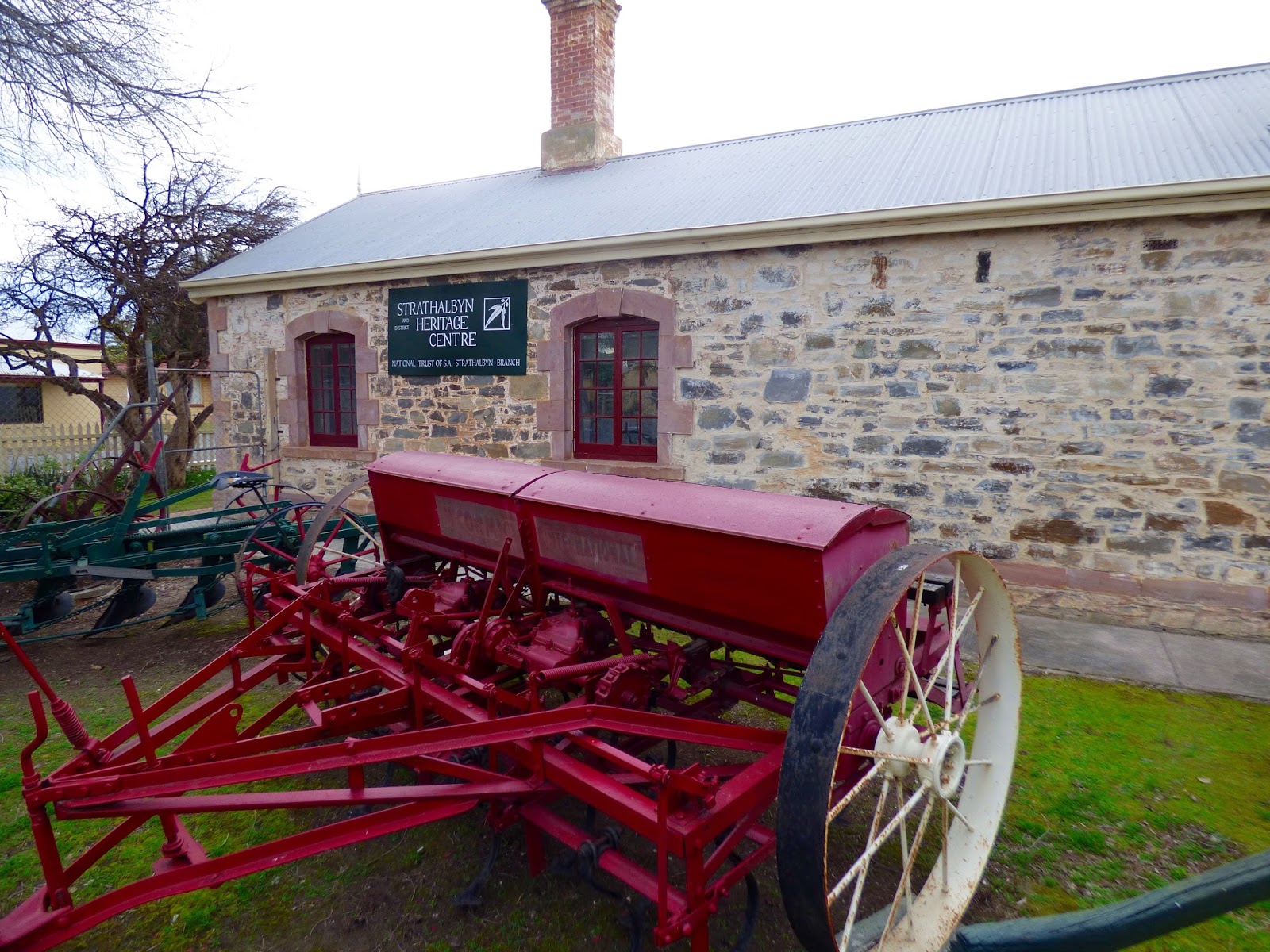
The Heritage Centre displays machinery from the early days.

The Town Hall


Charming vistas around every corner. 
The former John Wesley church is now the Chapel Theatre.
We strolled by the river...

 ... sat on a bench to view the grand St Andrews Church across the river ...

...then ventured over the river for a closer look.


We also came across this wonderfully dilapidated building ripe for restoration.


I love seeking out details, especially now I have a super-duper lens on my camera.


We had just finished our walk when I spotted these clouds with the sun shining through.

A lime milkshake for me, a coffee for Steve and a shared frangipane tartlet at the Bean Machine cafe ended a most rewarding day in Strathalbyn.

Monday, 8 August 2016

An interesting installation

Near the carpark opposite Warland Reserve in Victor Harbor is an intriguing monument.

The installation consists of three poles and is called On Occupied Territory. It was built in 2002 to mark the 200th anniversary of Mathew Flinders' meeting with Nicholas Baudin in Encounter Bay; the title recognises the fact that the land was occupied at the time of the meeting of these two explorers. The poles symbolise the association between the French, the British and the Aboriginal cultures.
On first looking at the poles you see lots of wires and sculptured objects on the top of each pole. It all makes sense when you read the interpretation plaques and learn what each aspect of the sculpture represents. The following information is adapted from the plaques.

  • The pole on the left in the photo is in the colours of the French flag and is topped by an anemometer and billowing sails symbolising the scientific achievements made by the French. Evidently the wavy effect on the sales is a reference to the bending of the earth's magnetic field, an important consideration when drawing accurate charts.  The wires on the poles symbolise ships' rigging.
  • The central pole is in the colours of the British flag and is topped by a cartographers arrow which points to the meeting site in Encounter Bay, and an octant which commemorates Flinders' navigation skills. 
  • The third pole in green and yellow represents the Aboriginal people. Atop the pole is a sculpture of the knobby club rush, a common grass that grows along the coastline, bending but never breaking under the force of the prevailing wind. It represents the endurance of the Ramindjeri Ngarrindjeri people.
The installation is the work of South Australian artist and designer Margaret Worth, whose work appears all over South Australia and the USA. Her work reflects the connection between people and places. To find out more about the artist look up margaretworth.com

I was impressed with another plaque erected by the local council that provided '... an expression of sorrow and an apology to the local Ngarrindjeri people'.

A little ways along the coast is a sign describing the meeting of Flinders and Baudin.

I took this photo of the installation facing the sun so it looks rather dramatic but in fact it was a very pleasant sunshiny day and not like this at all.