Monday, 8 August 2016

Four go adventuring again

It was with great pleasure that we welcomed Colin and Lorraine, our good friends from Perth, to the Robertson's retirement villa in Encounter Bay this week. Driving from Adelaide, with a detour to investigate the charms of Happy Valley and the Happy Valley Reservoir, the Potts arrived in good humour, ready to take on the challenge of the packed itinerary we had planned.

First up was a visit to the Langhorne Creek wineries. We love this area as it seems less commercial than the more well-known McLaren Vale to the north. There are only eight or so wineries here but each one has its special flavour.

Here is Vineyard Road cellar door, a fascinating mix of wines on one side, and olive oil soaps and cosmetics in the adjoining area.


Bremerton Wines is housed in marvellously restored stables.


An intricately carved gate at the entrance to Bremerton's cellar door.
Bleasedale Winery was founded by Frank Potts in 1850 but despite a lot of research Colin has failed to find any connection with his own family.


As with most wineries the roses always provide a good display (even thought this was winter and these hadn't been pruned yet).


We lunched at a microbrewery where Steve had the best butter chicken ever, I could stand my spoon upright in the pea and ham soup (which had huge pieces of succulent ham straight off the bone), Colin's Coorong mullet was pronounced delicious and Lorraine bought an order of these amazing curled chips - we couldn't work out how the chef got them this way.


Last stop of the day was at Rusticana. Here their specialty was zinfandel, durif .... and horseradish, as well as other delectable relishes and jam. I'm a pushover for fig jam and the one I bought had the added allure of ginger. The cottage on site was charming, framed by a blossoming almond tree.


Here is the paddock newly prepared to plant the horseradish.


On the way home we stopped at the old Milang Railway Station, now a railway museum. Both Colin and I share a love of all things train-related (though I can't say I've ever done any train spotting as Colin has in his native England).

The orange carriage was built in 1949.


We stopped by the enormous freshwater Lake Alexandrina, named by explorer Charles Sturt after Princess Alexandrina (who was later to become Queen Victoria) ....
... passed a smaller lake ...


... and then saw this rainbow.

After a well-earned rest back home, we set off to do the obligatory Encounter Wetlands walk just near our home; Colin gently corrected me that the ducks were, in fact, coots and the egrets were ibis.

The following day was Steve's birthday. After the celebrations and
opening of presents, we set off for Port Elliot, 10 minutes down the highway.  En route we stopped at Victor Harbor for a quick walk down the main street, browsing in the shops (we loved the Kiri Kiri Aboriginal shop), and for some posing by the whale tail fountain.


We love taking people to Port Elliot, a tiny seaside community of honey-coloured stone cottages, boutique shops, yummy cafes and wind-whipped coastal scenery, though on this day the wind was very well behaved.  Here Lorraine and Colin are reading one of the Whale Trail signs that Steve helped prepare for the Council; a set of 14 has just been installed all along the coast.


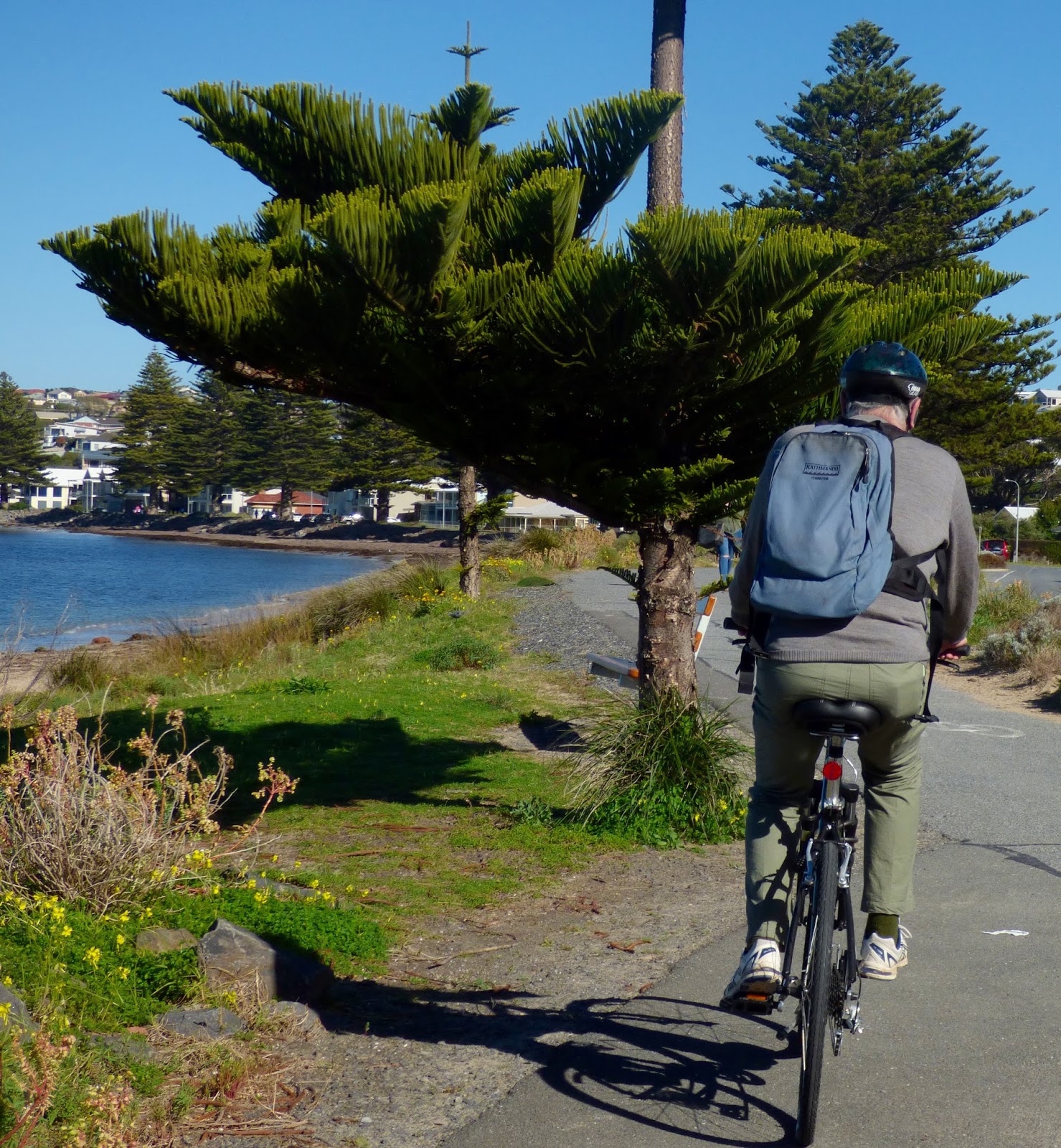
Back home, we walked along the nearby Encounter cycle path, but the weather was looking threatening so we turned homeward.
The following day, we arose early and headed for Granite Island. We cross the causeway, then it's a 1.5 kilometre walk around the island.


More posing...


More photographing ...


... and more exploring.


We met some locals who offered to take our photo for us, so we posed before another of Steve's Whale Trail signs. 


It was the end of a few days of fun and friendship. Thanks Lorraine and Colin for sharing our home and letting us show you some of the delights of the Fleurieu Peninsula.

Sunday, 17 July 2016

I conquer the Bluff

After  a bleak week weather-wise, it was good to see some sunshine, so I set off in high spirits to climb the Bluff. This is a large granite headland a kilometre or so away from home. Originally called Rosetta Head after someone's wife it is commonly referred to now as the Bluff. A walk to the top results in magnificent views over Encounter Bay and along the coast.

Destination: the Bluff.

Steve decided to cycle there but had to turn back as he had forgotten to check his tyres and one was very flat.
I continued on along the path but couldn't resist a shot of my favourite bird, the pelican (readers of previous blogs will understand). There were quite a few swimming or preening themselves on the rocks. Last week I spotted at least ten here but today I only saw four.


Just before the path ends, there is a lovely arbor. I always love this part of the walk.

The path ends at a boat ramp then a gravel road leads around the base of the Bluff.

Just off-shore here, a whaling station was established in 1837. Whaling was big for a while and a manned lookout was established on the summit of the Bluff from where spotters could see for miles. However, with a decline in Southern Right whales visiting the area the business was unprofitable and the station was abandoned in 1841. Today, whale numbers have increased and there are numerous sightings between May and October.

I loved the sunshiney yellow of these sour sobs (weeds, but they sure lift the spirit after days of relentless rain and gloomy skies).

I am getting nearer.  Soon I will see where a rough track to the summit begins. There is another approach via a bitumen road and car park, but I prefer this more adventurous way.

I begin the climb up the non-signposted track.


Halfway up I look back and spot this view. 
Looking ahead I see other climbers - it's the school holidays so lots of families are out enjoying themselves.
It's a steady slog though not particularly arduous and soon I can see views back from where I've come, as well as over the other side of the Bluff.


I go mad with the camera - everywhere I look I can see lovely coastal views. I especially like a view where the land seems to plunge headlong into the sea.


Near the summit I come across an old copper mine - or so the sign says, because all I can see is a sunken grassy patch. The mine was established in 1863 in order to search for copper and other minerals. However, it was a short-lived venture and the mine was abandoned in 1866.

It's a bit windy on the summit but you can see why the early whale spotters liked this spot.


I decide to go back along the signposted stepped track.


I ended up not far from the rocky base.

Nearby was a family fishing...

... and a man with his boat ...


... and the Whalers Inn restaurant.

Naturally, I couldn't resist a final farewell to the pelicans that were sunbaking on the rocks.

I felt blissful and satisfied as I walked back home. Another lovely day in this beautiful corner of the world.

Saturday, 16 July 2016

A ripping yarn - truth is indeed stranger than fiction

I have a bee in my bonnet about a book I have just read. It is 'Glory Girl' by Australian author Peter Yeldham. There is nothing wrong with the book itself as it is well-written and entertaining; it is the fact that it is based on actual facts that worries me.

It tells the story of two aviators in the exciting 1920s when flight was in its infancy. The two aim to be the first to fly from England to Australia. He (James ) is a World War I hero and she (Sarah) is an Australian keen to make her mark in the rarefied world of flying. They become lovers although both are married to others. The flight ends disastrously but they eventually get to Australia where they are received as heroes.  Then the Depression comes and their story goes from riches to rags. They eventually go to America, scraping the barrel to live. They are involved in a love triangle, a murder and a sensational trial. They split up and James decides to do one last flight to Africa, but crashes and his plane and body are not found for 30 years. 


Source: Goodreads


The story is told through the eyes of a narrator, Sarah's former boyfriend, who acts as a kind of Greek chorus, explaining what Bill and Sarah are thinking and their motives for their often bizarre antics. So far, so good. The story was fairly gripping but somehow the characters seemed over the top; James was obsessed with making his name in aviation and kept bleating that he would get a divorce but it never happened, and Sarah appeared self-absorbed and, excuse the pun, flighty.  But their exploits and lives were indeed intriguing as was the depiction of early aviators conquering the skies.

And then ... in the Acknowledgements at the back of the book, the author says that he based the story on real-life aviators Bill Lancaster and Jessie Miller. After a bit of Googling I read more of the fascinating story of this couple, almost exactly as they are depicted in Yeldham's supposedly fictional account. I found that he had not only based his story on their lives, but, it seemed to me, drawn from it in spades. In particular, the flight to Australia, the trial and James's crash in the desert and ultimate discovery are exactly as they happened in reality. He only changed names, added some scenes, and made up a few characters, the narrator being one of them.

Here is a photo  of the real-life Bill (James) and Jessie (Sarah).
Source: Widipedia


So my question is: Why not write a ripping biography? Yeldham has the research and writing skills to do this. I felt that he diminished these people by presenting them as fictional characters. I suppose as  stand-alone story, and if a reader is not interested in the actual history, then the book is a success.

My husband disagrees with my stand on this. 'Authors should be allowed the privilege of deciding for themselves if they want to create a fictional account from real-life events', he says. 'Humph', I reply. I know authors do take elements of actual stories to create their own literary fiction, but in my opinion this was just real-life turned into fiction by changing people's names.

Anyway, I have discovered another book called "Bill Lancaster: The Final Verdict' which is a non-fiction version of the same story, and have ordered it from the library.
Source: Pen and Sword Books (www.pen-and-sword.co.uk)

So, what do you think? Am I just an annoying pedant or do I have a case?